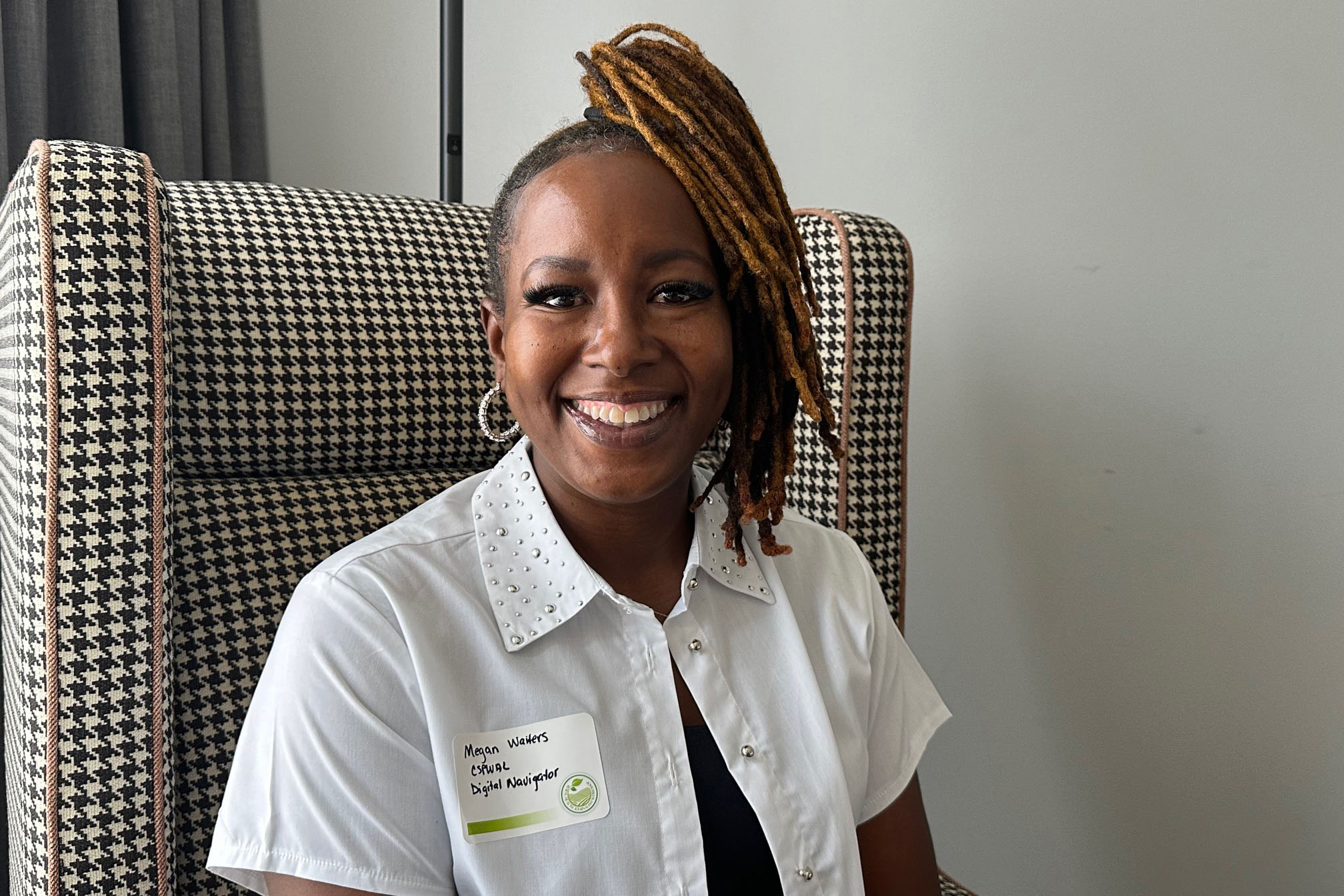
Megan Waiters can recite the tales of dozens of individuals she has helped connect with the web in western Alabama. A 7-year-old who couldn’t do classwork on-line with no pill, and the 91-year-old she taught to verify well being care portals on a smartphone.

“They’ve well being care wants, however they don’t have the digital expertise,” mentioned Waiters, who’s a digital navigator for an Alabama nonprofit. Her work has concerned gifting away computer systems and tablets whereas additionally educating courses on the way to use the web for work and private wants, like banking and well being. “It’s like a international area.”
These tales at the moment are bittersweet.
Waiters is a part of a community of digital navigators throughout the nation whose work to deliver others into the digital world was, not less than partially, propped up by a $2.75 billion federal program that abruptly canceled funding this spring. The halt got here after President Donald Trump posted on his Truth Social platform that the Digital Fairness Act was unconstitutional and pledged “no extra woke handouts based mostly on race!”
The act lists exactly whom the cash ought to profit, together with low-income households, older residents, some incarcerated individuals, rural Individuals, veterans, and members of racial or ethnic minority teams. Politicians, researchers, librarians, and advocates mentioned defunding this system, together with different adjustments in federal broadband initiatives, jeopardizes efforts to assist rural and underserved residents take part within the trendy economic system and lead more healthy lives.
“You would see lives change,” mentioned Sam Helmick, president of the American Library Affiliation, recalling how they helped grandpas in Iowa verify prescriptions on-line or laid-off manufacturing facility staff fill out job purposes.
The Digital Fairness Act is a part of the sweeping 2021 infrastructure regulation, which included $65 billion to construct high-speed web infrastructure and join tens of millions with out entry to the web.
This 12 months, Congress as soon as once more pushed for a contemporary method to assist Individuals, mandating that state leaders prioritize new and rising applied sciences via its $50 billion Rural Well being Transformation Program.
A KFF Health News analysis discovered that almost 3 million individuals in America stay in areas with shortages of medical professionals and the place trendy telehealth companies are sometimes inaccessible due to poor web connections. The evaluation discovered that in about 200 principally rural counties the place useless zones persist, residents live sicker and die earlier on common than individuals in the remainder of the nation. Entry to high-speed web is amongst a number of social elements, like meals and protected housing, that assist individuals lead more healthy lives.
“The web gives this additional layer of resilience,” mentioned Christina Filipovic, who leads the analysis for an initiative of the Institute for Enterprise within the World Context at Tufts College. The analysis group found in 2022 that entry to high-speed web correlated with fewer covid deaths, notably in metro areas.
Throughout the covid-19 pandemic, federal lawmakers launched a subsidy program paid for by the infrastructure regulation. That assist, known as the Reasonably priced Connectivity Program, aimed to attach extra individuals to their jobs, colleges, and medical doctors. In 2024, Congress didn’t renew funding for the subsidy program, which had enrolled about 23 million low-income households.
This 12 months, U.S. Commerce Secretary Howard Lutnick revamped and delayed the infrastructure regulation’s building initiative — often called the Broadband Fairness, Entry, and Deployment Program, or BEAD — after saying plans to reduce regulatory burdens. Greater than 40 states and territories have submitted last proposals to increase high-speed web to underserved areas beneath the administration’s new pointers, in keeping with a Commerce Department dashboard.
In Could, the Digital Fairness Act’s funding was terminated inside days of Trump’s Reality Social submit. Whereas many states in 2022 had obtained cash to plan their packages, the following spherical of funding, designated for states and companies to implement the plans, had largely been awarded however not distributed.
As an alternative, federal regulators — together with the Nationwide Telecommunications and Info Administration, the federal company overseeing implementation of the Digital Fairness Act — notified recipients that the grants can be terminated. The grants had been created and administered with “unconstitutional racial preferences,” in keeping with the letter.
In Phoenix, officers discovered in January that town was slated to get $11.8 million to extend web entry and educate digital literacy, however they obtained an e-mail Could 20 stating that every one grants, “apart from grants to Native Entities,” had been terminated. “It’s a disgrace,” mentioned Phoenix Mayor Kate Gallego, a Democrat. The cash, she mentioned, would have helped 37,000 residents get web entry.
Georgia’s Democratic leaders in July sent a letter to Lutnick and NTIA’s then-acting administrator, Adam Cassady, urging reinstatement of the cash, noting that the federal lower ignores congressional intent and violates public belief.
The act’s creator, Sen. Patty Murray (D-Wash.), mentioned during an online press conference in Could that Republican governors in 2024 supported the regulation and its funding when every state touted finishing its required digital fairness plans and requested for sources.
“I can’t consider there aren’t Republican governors on the market which might be going to affix with us to combat again on this,” Murray mentioned, including “the opposite means is thru courts.”
All 50 states developed digital fairness plans after months of focus teams, surveys, and public remark intervals. NTIA Digital Fairness Director Angela Thi Bennett, throughout an August 2024 interview with KFF Well being Information, mentioned the “intentional neighborhood engagement” by federal and state leaders to ship broadband to unserved communities was “the best demonstration of participatory democracy our nation has ever seen.”
Thi Bennett couldn’t be reached for touch upon this text. NTIA spokesperson Stephen Yusko mentioned the company “won’t be able to accommodate” a request for an interview with Thi Bennett and didn’t reply to questions for this text.
Caroline Stratton, a analysis director on the Benton Institute for Broadband & Society, mentioned the act’s funding allowed states to employees places of work; determine present high-speed web packages, together with these working inside different state companies; and create plans to fill the gaps.
“This despatched people out wanting,” Stratton mentioned, to see whether or not companies within the state had been already engaged on well being enchancment plans and to ask whether or not the broadband work may contribute and “actively assist transfer the needle.”
State grant purposes included targets to promote health care access. In Mississippi, the plan consists of the state college and one other company’s well being enchancment plan, Stratton mentioned.
Whereas states had been required to create packages that will assist particular lined populations, some states modified the language or added subcategories to incorporate different populations. Colorado’s plan included immigrants and “people experiencing homelessness.”
“In each state, there’s a loss,” mentioned Angela Siefer, government director of the Nationwide Digital Inclusion Alliance. The nonprofit, which was awarded nearly $26 million to work with organizations nationwide however didn’t obtain any funds, filed a lawsuit Oct. 7 in search of to power Trump and the administration to distribute the cash.
“The digital divide is just not over,” Siefer mentioned.
The nonprofit’s grant had been deliberate to assist digital navigators in 11 states and territories, together with Waiters. Her employer, the nonprofit Neighborhood Service Applications of West Alabama, anticipated to obtain a $1.4 million grant.
Prior to now two years, Waiters spent hours driving the roads of rural Alabama to achieve residents. She has distributed 648 gadgets — laptops, tablets, and SIM playing cards — and helped a whole bunch of purchasers via 117 two-hour digital expertise courses at libraries, senior facilities, and office improvement packages in and round Tuscaloosa, Alabama.
Individuals of “all races, of all ages, of all monetary backgrounds” who didn’t “match into our typical minority class” had been helped via her work, Waiters mentioned. Trump and his administration ought to know, she mentioned, “what it truly appears to be like like for the individuals I serve.”